Balanced Coupling

Because adding a feature shouldn’t feel like defusing a bomb.

What is Balanced Coupling?

Balanced Coupling is an innovative framework for modular software design. Built on over 50 years of software engineering insights, it distills proven principles and techniques into a concise, easy-to-use guide for making software design decisions.

You might be wondering—do we really need yet another software design tool? Software engineering is hard. To be successful, you need to learn design patterns, architectural styles, engineering principles, and countless other "best practices"—so why invent yet another?

What is Balanced Coupling?

It Shouldn’t Be This Hard

It Shouldn’t Be This Hard

Throughout my career, I’ve always believed that it should be easy to do the right thing. Ironically, more often than not, the most important things are the hardest to get right. This is especially true in software design. Good module boundaries should be evident—not something you have to fight for. Renaming a module shouldn’t break half the system, and adding a feature shouldn’t feel like defusing a bomb.

From Struggle to Structure

These were exactly the kinds of situations I found myself in when I was leading a failed microservices-based project. Trying to understand why something that seemed to work so well for industry superstars had gone so wrong for us led me to revisit the concept of coupling—and the various models used to evaluate it. I eventually understood why the project had failed, but I also discovered how difficult it is to apply models and methodologies coined half a century ago to modern software systems.

That’s how the model of Balanced Coupling came to life.

From Struggle to Structure

What Balanced Coupling Offers

What Balanced Coupling Offers

I’m Vlad Khononov, and I created the Balanced Coupling model to bridge the gap between classic software design theory and the messy, fast-paced reality of modern systems. Balanced Coupling doesn’t just adapt classic coupling models to fit today’s engineering practices—it brings them together into a cohesive tool for making design decisions. It helps you evaluate whether a choice you’re about to make will lead to greater modularity or deeper complexity. And it’s pragmatic, too: it highlights the areas of your system that need the most attention, helping you focus your efforts where they’ll have the biggest impact.

Getting Started

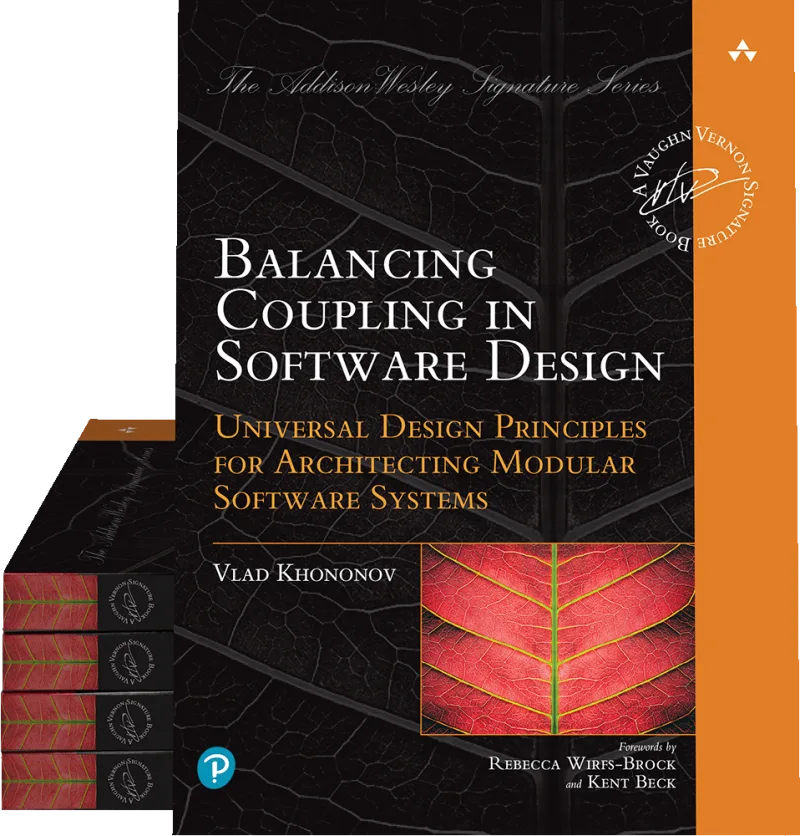
Most importantly, Balanced Coupling is simple. You don’t need to study a stack of books or accumulate years of experience. All it takes is one formula and an understanding of three key dimensions of coupling. This website will give you the core concepts to get started. If you want to go deeper, Balancing Coupling in Software Design explores the ideas in full detail, with examples, case studies, and practical guidance.

Getting Started

Coupling and Cohesion in Software Design: FAQ

What is Coupling?

What is Coupling?

Coupling is any dependency between two components of a system. The design of that dependency defines the likelihood of a change in one component requiring a corresponding change in the other. Coupling is the glue that holds systems together, but how it’s designed determines whether it makes the system more modular or more complex.

What is Cohesion?

Stated simply, cohesion is the “good coupling.” It’s a design that locates components that have to change together, due to the nature of the business domain, close to each other. In the terms of the Balanced Coupling model, high cohesion occurs when components that share considerable knowledge are located at low distance, making co-evolution cheap.

What is Cohesion?

What are the types of coupling?

What are the types of coupling?

The classical taxonomies for evaluating coupling are Module Coupling and Connascence. However, there are more reasons for components to change together that aren’t covered by these two models. Because of that, Balanced Coupling defines three explicit dimensions of coupling and provides models to evaluate each: integration strength, distance, and volatility.

How do you evaluate coupling?

Coupling affects system design in multiple dimensions, and no single model covers all of them. The Balanced Coupling model combines suitable models for each dimension into a comprehensive analysis of how coupling affects your system. The balanced coupling formula reflects how the dimensions interact and predicts whether your design will lead to modularity or complexity.

How do you evaluate coupling?

What is the Balanced Coupling model?

What is the Balanced Coupling model?

Balanced Coupling is a model that distills over 50 years of software engineering knowledge into a simple, easy to apply formula. The vast majority of design patterns, architectural styles, and engineering principles can be explained through it.

Is Balanced Coupling relevant in the AI era?

More than ever. As AI-assisted engineering turns code into a commodity, modular design becomes the real differentiator. Balanced Coupling provides a framework for quickly evaluating design decisions, whether made by humans or AI, and steering them toward long-term evolvability.

Is Balanced Coupling relevant in the AI era?

Don’t microservices solve coupling?

Don’t microservices solve coupling?

Microservices are modularity at a higher level of abstraction. Getting modularity right is still hard, and that’s why so many microservices refactorings ended up as distributed monoliths. The Balanced Coupling model helps you analyze whether your distributed design is heading toward modular services or a distributed big ball of mud, by analyzing the knowledge shared across microservices’ boundaries.

What Others Say